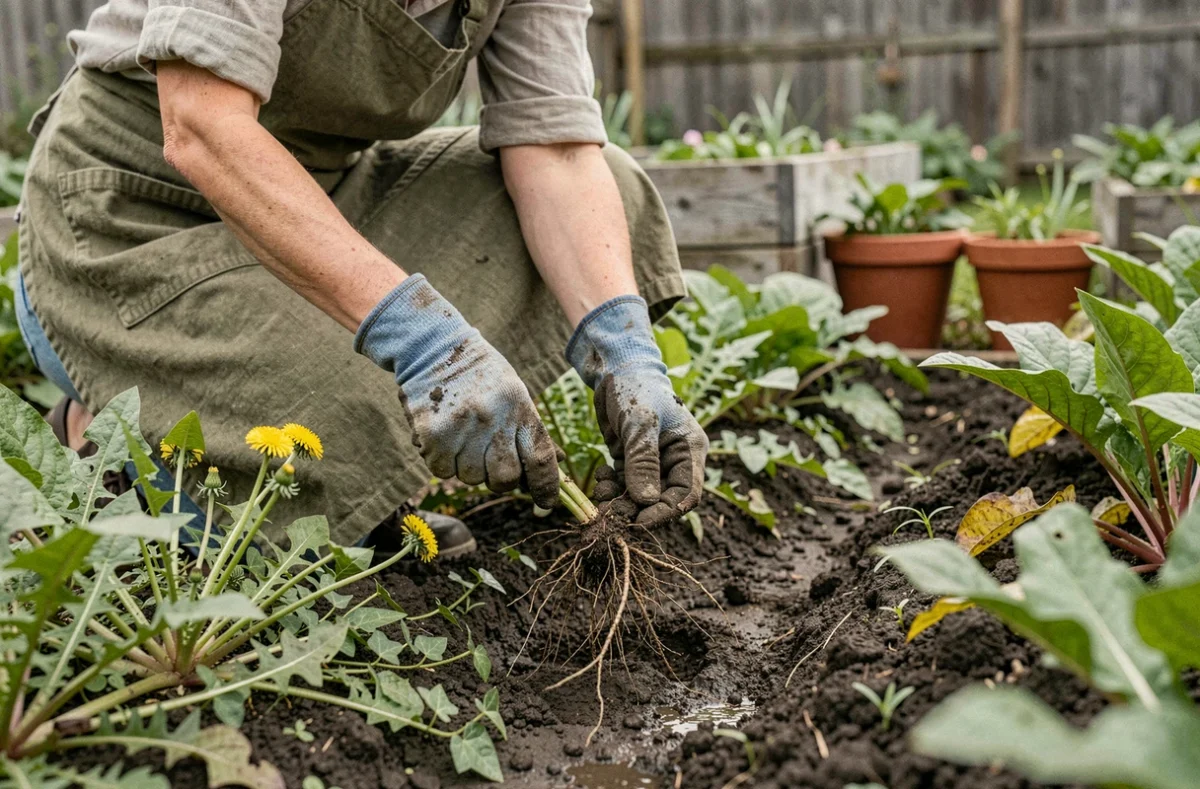
A weed is a plant that grows spontaneously where it has not been sown, competing directly with crops or ornamental plants for light, water, and soil nutrients. To sustainably eliminate weeds in the garden, it is essential to understand their mode of reproduction, as pulling a stem without extracting the root system or preventing the germination of new seeds only postpones the problem by a few weeks.
White vinegar and salt in the garden: a natural weeding method not always legal
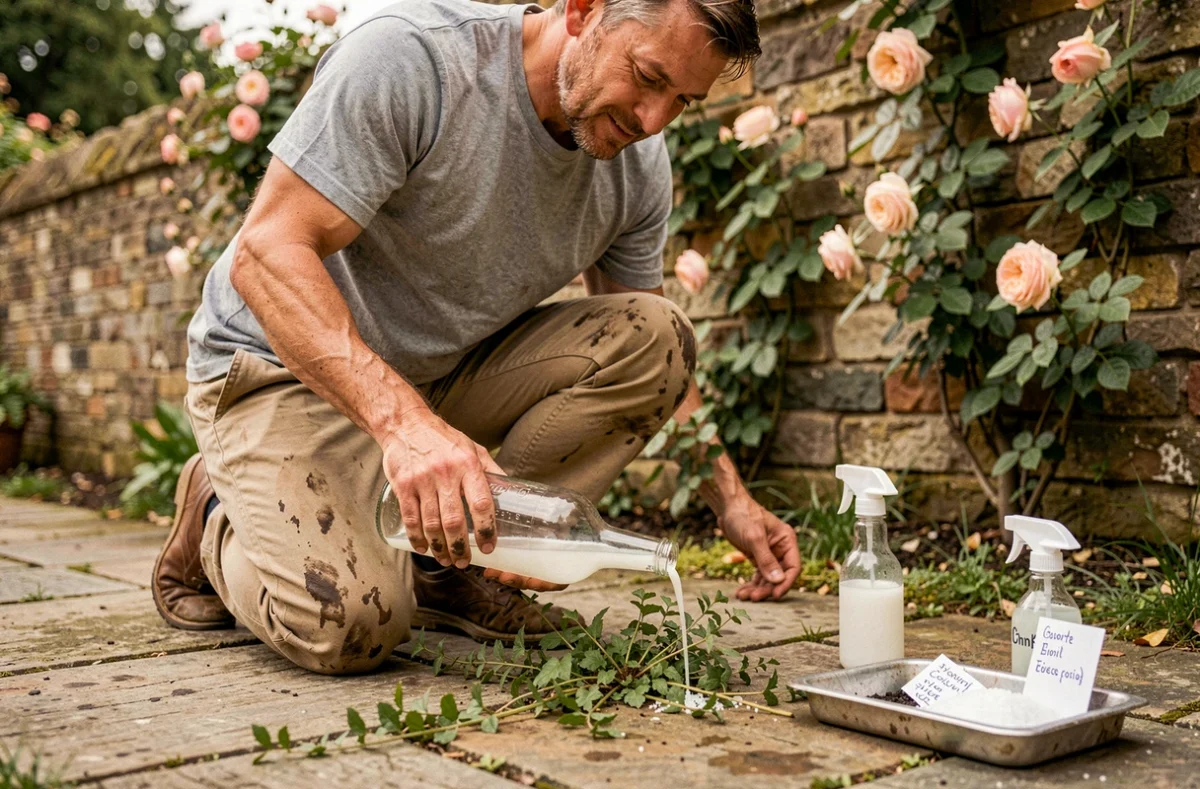
White vinegar and table salt appear on most lists of homemade herbicides. Their contact effectiveness on aerial parts is real: acetic acid burns the leaves, and sodium chloride dehydrates plant tissues.
The problem lies elsewhere. In France, a product used as a herbicide must be authorized for that use. Household white vinegar and cooking salt are not approved herbicides. Using them for this purpose may therefore constitute an offense, even if they are sold in supermarkets in the food section.
Beyond the regulatory framework, salt accumulates in the soil and disrupts the absorption of water by the roots of all plants, including those you wish to keep. Several successive treatments with coarse salt can render a plot unsuitable for cultivation for years. To better understand these limits and discover the gardening tips from Les Défricheurs, it is worth distinguishing what actually works from what silently damages the soil.
Pelargonic acid: understanding the limits of biocontrol herbicides
Pelargonic acid is the active ingredient in many herbicides labeled “natural” in garden centers. It acts by contact: it destroys the cuticle of the leaves, causing rapid drying of the aerial parts. Visually, the result is spectacular within a few hours.
This surface action does not destroy deep roots. On perennials, rhizomatous plants (bindweed, couch grass), or tap-rooted weeds (dandelion), regrowth is predictable. Several applications are often necessary before exhausting the root reserves, which multiplies the cost and labor time.
A contact herbicide does not replace root extraction for species with deep rooting. It remains useful on young seedlings, mosses, or annual grasses on the surface, particularly between the slabs of a terrace where manual weeding is difficult.
Mulching in the garden: what soil cover really prevents
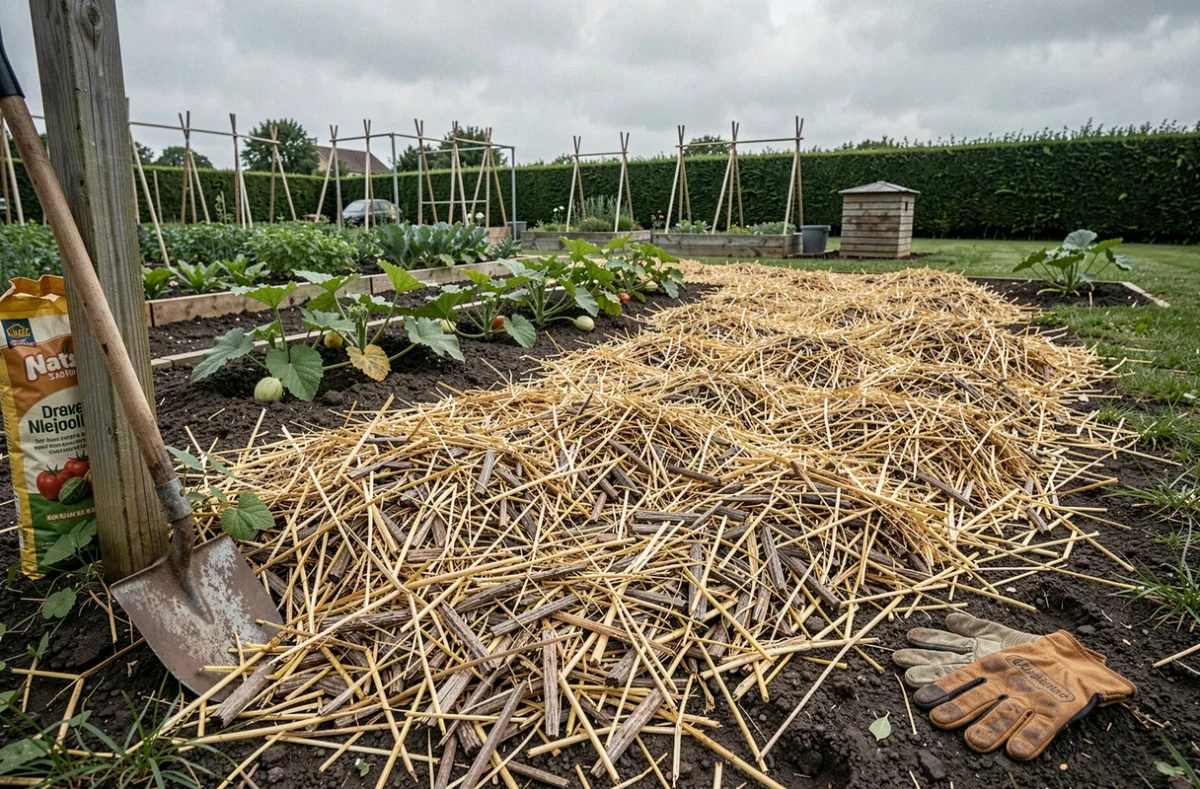
Mulching reduces the light that reaches the soil surface. Without light, the majority of weed seeds do not germinate or die shortly after sprouting. This is its main mechanism, and it works well against new germinations.
However, a mulch placed on already established weeds does not eliminate them. Perennials with rhizomes can penetrate an organic mulch layer within a few weeks. Therefore, before mulching, it is necessary to weed the area manually or mechanically, and then apply a sufficient thickness to maintain darkness at the soil level.
The mulching material modifies soil biology
Research published in BMC Microbiology in 2020 observed that soil microbial communities varied according to the type of cover used (plant shells, plastic film, etc.). Therefore, the choice of mulch is not just a matter of aesthetics or price.
- Organic mulches (wood chips, straw, dead leaves) decompose and nourish soil life but need to be renewed regularly.
- Mineral mulches (slate, pumice) do not degrade and are suitable for ornamental beds but do not contribute to fertility.
- Woven fabrics effectively block light but limit gas and water exchanges if they cover large areas.
Adapting the material to the use (vegetable garden, path, perennial bed) avoids solving a weed problem by creating a biological imbalance.
Mechanical and thermal weeding: acting at the right time on the roots
Pulling weeds in wet weather, when the soil is loose, allows for a greater portion of the root system to be extracted. This is a condition often overlooked. In dry and compact soil, the stem breaks at ground level, and the intact root produces new shoots within a few days.
Thermal weeding (flame or steam) causes a thermal shock that bursts plant cells. It acts quickly on aerial parts, but its effect on deep roots remains limited, as with pelargonic acid. It is especially effective on seedlings and young grasses before they develop a deep root network.
Frequency and timing of weeding
The challenge of sustainable weeding depends as much on timing as on technique. Acting before seed set prevents the dispersion of new seeds in the soil. A single plant of chickweed or amaranth can produce thousands of viable seeds for several years in the ground.
- In spring, weed annuals as soon as they reach the two to four leaf stage, before deep rooting.
- In summer, monitor creeping perennials (creeping cinquefoil, buttercup) that quickly colonize free spaces.
- In autumn, cover bare plots with mulch or green manure to occupy the soil before winter.
A bare soil is always an invitation to weed germination. Systematically covering each freed plot, whether with mulch, green manure sowing, or new planting, remains the most reliable method to reduce weeding in the long term. The combination of careful root extraction, appropriate mulching, and a timing schedule aligned with the life cycle of weeds produces far more sustainable results than a repeated surface treatment every month.