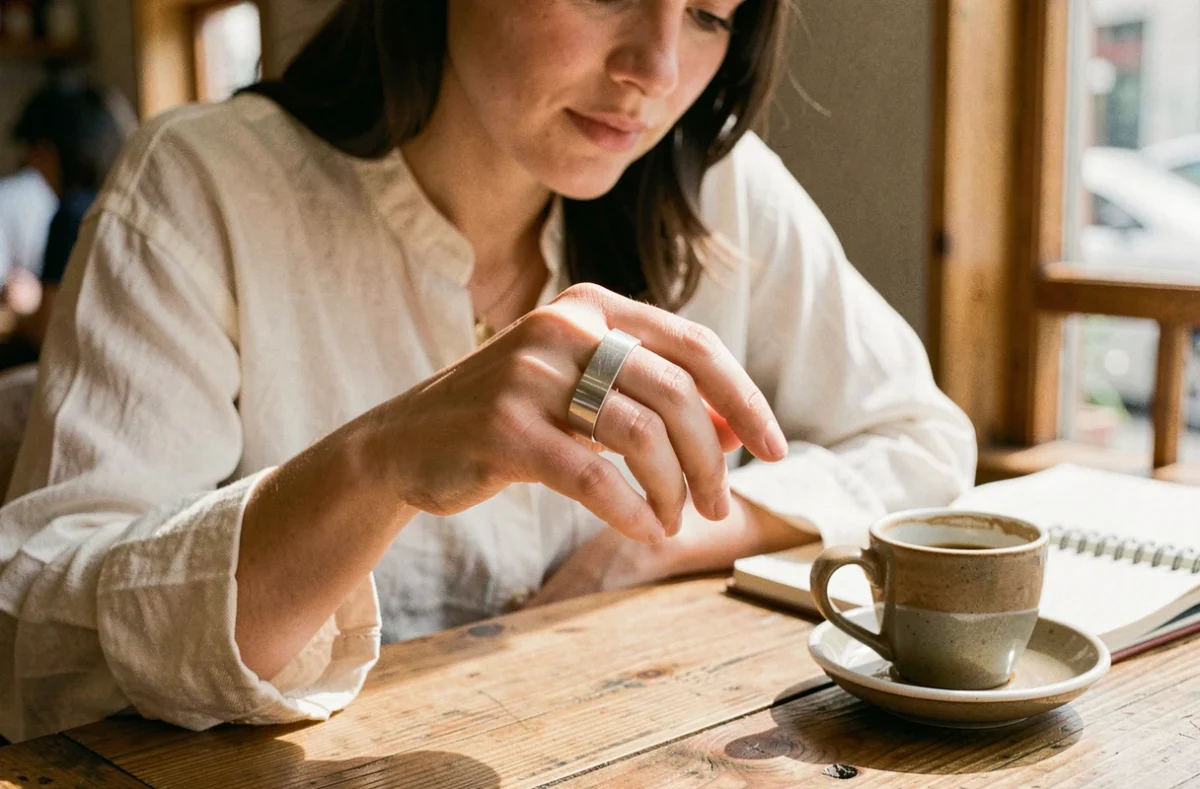
The thumb ring is one of the few pieces of jewelry whose history began with a purely functional purpose before it became a style accessory. Understanding why wear a thumb ring means untangling what comes from archaeology, cultural symbolism, and simple aesthetic preference.
The meanings attributed to it vary across eras, regions, and the finger chosen—left or right. This article compares these different interpretations to identify what is based on documented facts and what is a matter of contemporary interpretation.
Thumb rings: functional origins versus symbolic interpretations
Before it became a symbol, the thumb ring served as a tool. The Metropolitan Museum of Art describes South Asian archers’ thumb rings as both functional and decorative objects: they protected the thumbs of archers who drew the bowstring with that finger.
The Smithsonian’s National Museum of Asian Art, meanwhile, describes Chinese jade rings inspired by these archery guards, some ornamental forms of which were later worn as pendants. The practical use came before the symbolism, and this lineage explains why the earliest thumb rings were large and rigid.
The transition to a decorative piece happened gradually. Precious materials (jade, gold) replaced durable ones, and the ring lost its protective function to become a marker of status or personal taste. Knowing why wear a thumb ring often comes down to choosing between these two legacies: an object that tells an ancient story or one that expresses a contemporary style.
| Criteria | Historical use (archery) | Contemporary use (style) |
|---|---|---|
| Primary function | Protecting the thumb while shooting a bow | Aesthetic and symbolic accessory |
| Typical materials | Jade, bone, hardened leather | Silver, gold, steel, ornamental stones |
| Predominant shape | Wide, thick ring with a smooth surface | Thin bands, signet rings, open rings |
| Associated meaning | Archer’s status, military rank | Independence, self-expression |
| Associated gender | Primarily male | Unisex, worn by women and men |

Thumb ring meaning by gender and hand
Jewelry websites attribute meanings such as independence, strength of character, and boldness to thumb rings. These interpretations are consistent across sources, but they remain modern readings, not universal codes.
A thumb ring is not a reliable way to infer someone’s personality or status. It may simply express personal taste, with no hidden message. This distinction is rarely made in competing articles, which often present these meanings as established facts.
Thumb rings for women and men
For women, thumb rings are often associated with emancipation and self-assertion. Sources link them to a desire to stand apart from traditional conventions (wedding rings on the ring finger, engagement rings).
For men, a signet ring on the thumb remains a popular choice. It is seen as a sign of a strong character and is sometimes associated with an unconventional style. In both cases, the meaning depends more on the wearer’s intention than on any established code.
Left or right thumb
Some interpretations distinguish the left thumb (associated with inner life and personal will) from the right thumb (associated with social influence and authority). These distinctions are not based on any specific historical source and are mostly part of recent popular tradition.
- The left thumb is often described as the finger of introspection and personal determination.
- The right thumb is linked to outward expression, leadership, or career ambition.
- The difference in meaning between the two hands has no documented basis in anthropology or jewelry history.
Comfort and practical considerations when wearing a thumb ring
The thumb is the hand’s most frequently used finger. It is involved in almost every gripping motion: picking up an object, turning a key, writing, and using a phone. An ill-fitting ring on the thumb is more uncomfortable than on any other finger.
Several comfort factors are worth checking before you buy:
- Ring width: a ring that is too wide rubs against the index finger when pinching. Moderately wide bands help reduce this friction.
- Inner profile: a domed interior (known as a “comfort fit”) reduces friction against the skin when the thumb bends repeatedly.
- No protruding details: a raised setting or embossed design can catch on surfaces during everyday activities and cause discomfort.
- Material: silver and steel are among the most common materials for thumb rings because they withstand impacts better than fine gold.

Thumb rings and dress codes: what the style really says
In current jewelry trend analysis, the thumb ring works as an accessory that creates visual contrast. It draws the eye precisely because it sits in an unusual position.
Pairing it with other rings on the same hand creates a layered effect that stylists call “ring stacking.” Set apart from the other fingers by a natural gap, the thumb lets you add a piece of jewelry without visually overcrowding the hand. A simple thumb ring paired with a thin ring on the index or middle finger creates an asymmetrical balance.
The choice of metal also plays a role in creating a cohesive look. Mixing gold and silver on the same hand is divisive. The prevailing trend in contemporary jewelry favors sticking to one metal tone per hand to avoid a mismatched look.
Thumb rings as unisex jewelry
One of the thumb ring’s distinctive features is its unisex appeal. The most popular styles (smooth bands, textured bands, minimalist signet rings) are not gender-specific. This versatility partly explains the growing presence of thumb rings in unisex collections.
A thumb ring is a statement piece in its own right. Its placement, its history as a functional object turned ornament, and the lack of rigid social codes surrounding it make it a piece of jewelry whose meaning belongs first and foremost to the person wearing it.