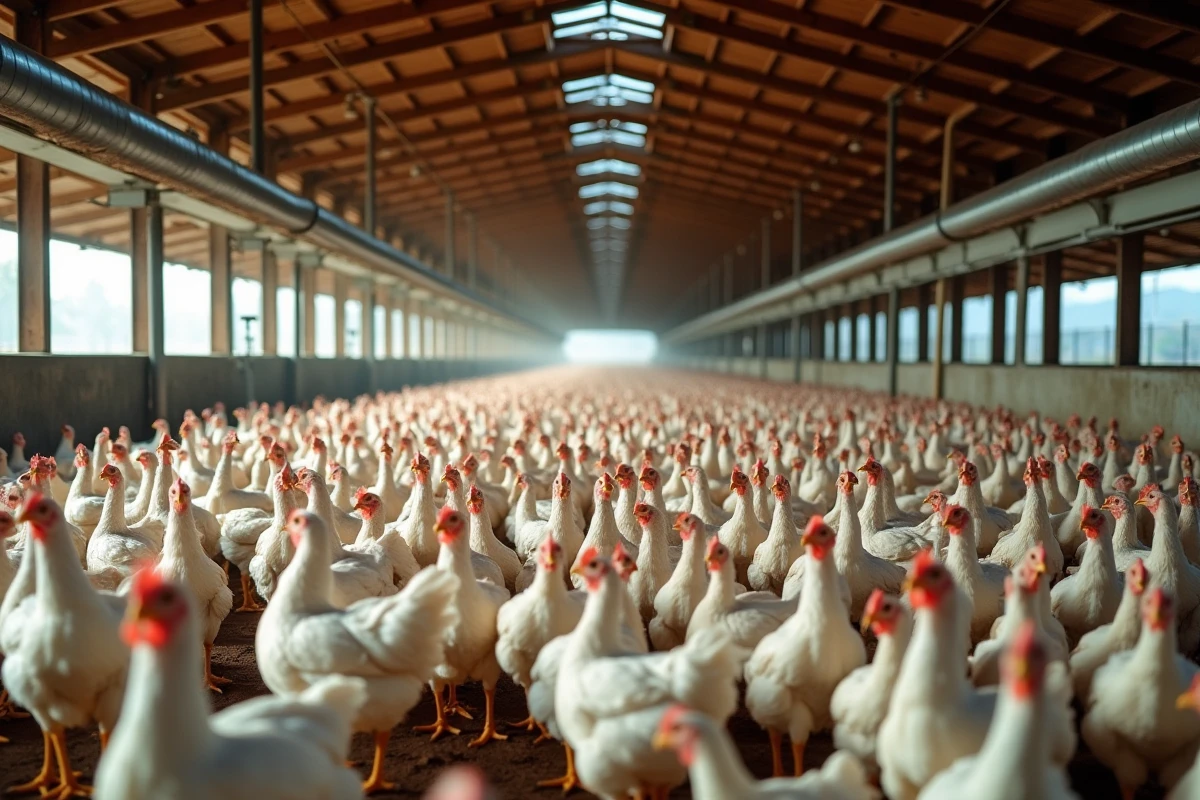
The global chicken production is reaching unprecedented levels, driven by a handful of countries where poultry sectors are operating at full capacity. Three regions dominate the dynamics: Brazil, the United States, and China. Understanding why these countries concentrate the records requires examining their production models, export strategies, and health constraints that shape their competitiveness.
Slaughter capacity and batch rotation: the technical factor behind chicken records
The volume of chickens produced in a country depends less on available agricultural land than on the speed of batch rotation in farming. In Brazil, integrators manage short cycles, with fast-growing strains and high densities per building. This model allows for multiple annual flocks at the same site.
In the United States, the sector relies on a comparable scheme, but with an even more pronounced industrial concentration. A few large groups control the entire chain, from parent genetics to processing. This vertical integration reduces downtime between batches and optimizes the occupancy rate of slaughterhouses.
China, for its part, has massively invested in modernizing its farms since the end of the 2010s. The country now combines large-scale intensive operations with a network of restructuring family farms. The coexistence of these two models explains the rapid growth of Chinese volumes.
To grasp the extent of this dynamic, it is important to note that the number of chickens worldwide continues to grow year after year, driven by the demand for affordable animal protein in both emerging countries and mature economies.

Brazil, United States, China: why these three countries are breaking poultry production records
The USDA forecasts that global chicken production will reach 14.7 million tons on the global market by 2026, a new record. Brazil, the United States, and China are among the main drivers of this increase.
Brazil, the exporting machine
Brazil does not just produce massively: it exports a significant portion of its volumes. Its advantage lies in low production costs (abundant local corn and soy), a climate that allows for multiple grain harvests per year, and sanitary agreements with a large number of importing countries.
The Brazilian sector also benefits from a competitive workforce and port infrastructures dedicated to refrigerated freight. Global chicken exports continue to soar, largely supported by Brazilian volumes.
The United States, producer and consumer
American production is primarily oriented towards the domestic market, where per capita chicken meat consumption ranks among the highest in the world. American poultry genetics, dominated by a few commercial lines, allows for very high feed conversion rates.
The American export surplus complements Brazilian supply in international markets, particularly in Asia and Mexico.
China, growth and restructuring
China has accelerated the consolidation of its poultry sector following health crises related to avian influenza. Investments in biosecurity and farm automation have led to a significant increase in productivity per building. The country remains primarily a producer focused on its colossal domestic demand.
Global chicken exports: the shift towards major producing regions
For several years, we have observed a shift in production towards countries capable of feeding international flows. The question of the record is no longer limited to the total volume produced, but encompasses the ability to export massively while satisfying local demand.
Brazil and China illustrate two opposing logics. The former exports a high proportion of its production, while the latter absorbs almost all of its volumes in its own market. The United States sits between the two, with a dominant domestic market but a structural export flow.
- Brazil accounts for a major share of global chicken exports thanks to its among the lowest production costs and specialized port logistics.
- The United States primarily exports to Mexico, Southeast Asia, and certain African markets, with low-value cuts (wings, backs) in high demand.
- China remains a net importer in certain segments (notably chicken feet), despite its record production, creating an atypical cross-trade.
Poultry production in the European Union and France: regional leadership, not global
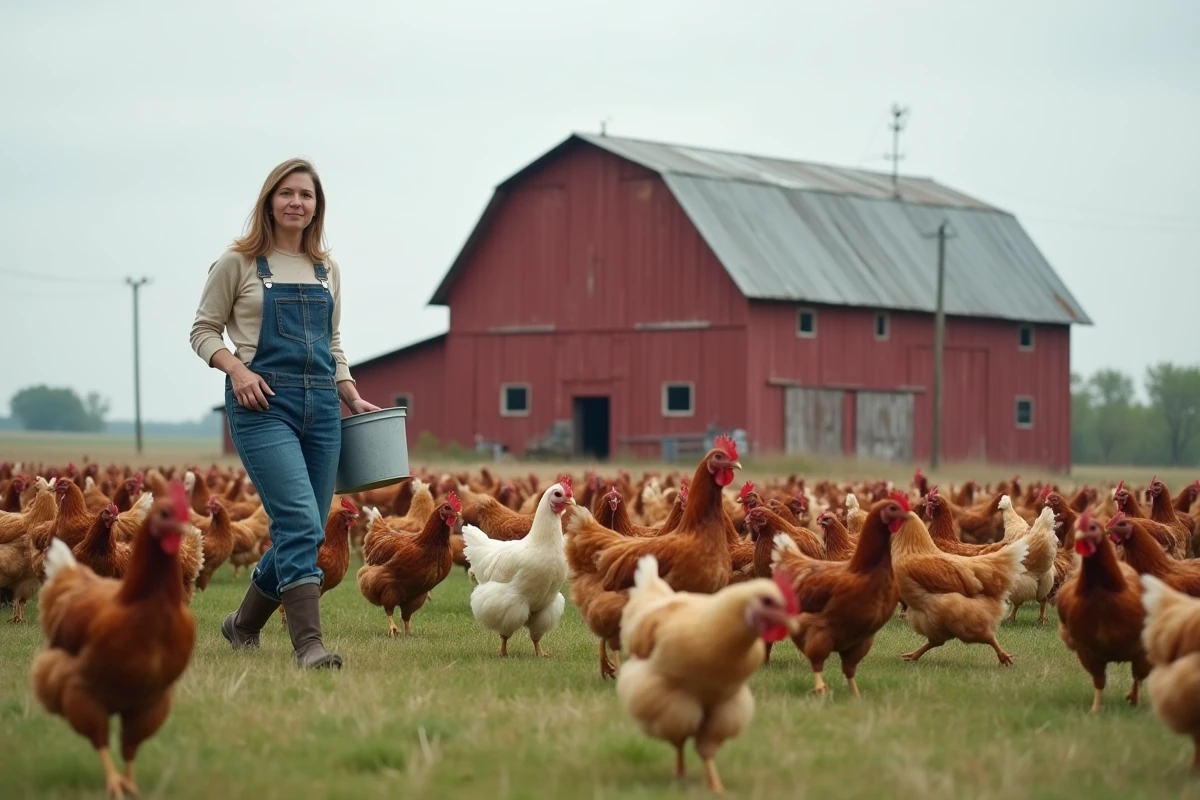
The European Union produces significant volumes of poultry, but its weight remains modest compared to the three giants. France ranks as the third-largest poultry producer in Europe, with a model that emphasizes qualitative differentiation rather than raw volume.
The French sector focuses on quality labels: Label Rouge, organic certifications, free-range farming. More than one in four French poultry is produced under specific specifications. This positioning, while not generating records in tonnage, provides an advantage in high-value markets.
- France is the leading free-range sector in Europe, a commercial asset but a constraint on volume per farm.
- The Netherlands, in contrast, embodies a model of advanced technological optimization with very high yields per square meter, without rivaling Brazil or the United States in absolute volume.
- European chicken production accounts for about eight out of ten poultry among the species produced on the continent, with the remainder divided between turkey, duck, and guinea fowl.
Since 2016, poultry meat has become the most produced meat in the world, surpassing pork. This structural shift reflects both the favorable production cost of chicken, its acceptability in all food cultures, and the speed of its farming cycle. The countries that are breaking records today are those that have been able to industrialize these advantages on a large scale while securing their sectors against episodes of avian influenza.