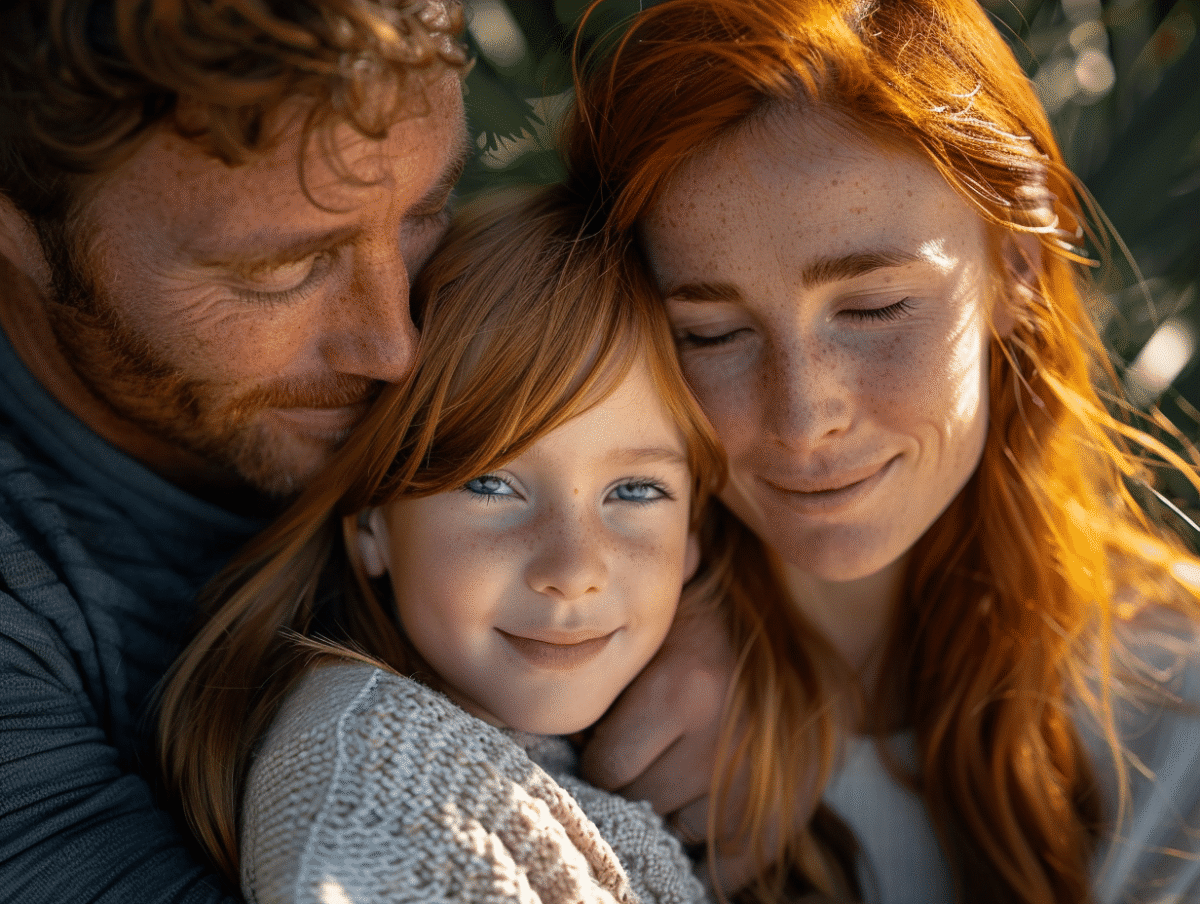
Hair color, a characteristic trait that fascinates both for its diversity and its heredity. Among the shades, red hair, with its fiery glow, captivates and sparks curiosity. This chromatic rarity results from a specific genetic alchemy, where the MC1R gene plays a predominant role. For couples aspiring to influence the hair palette of their offspring, understanding the subtleties of genetics proves essential. The alleles of genes, combined with Mendel’s laws, can sometimes be directed to increase the chances of welcoming a child with fiery hair.
The genetics of red hair: understanding the heredity of this rare color
The mystery surrounding red hair color unfolds in light of scientific advances. At the heart of the phenomenon is the MC1R gene, the architect of hair pigmentation, orchestrating the production of melanin. Two types of melanin coexist: eumelanin, which is rather brown or black, and pheomelanin, with yellow-orange hues. In red-haired individuals, it is the latter that predominates, offering a unique palette of shades ranging from Venetian blonde to auburn. Genetics does not stop at the simple prevalence of pheomelanin. The diversity of red shades reflects the complexity of genetic interactions.
Red-haired individuals, representing 1 to 2% of the global population, inherit this unique color due to the presence of variants of the MC1R gene. Nadem Soufir, a geneticist specializing in pigmentation, specifies that for a child to be born red-haired, they must inherit two copies of the mutated MC1R gene, one from each parent. These recessive mutations must meet to manifest the red color. Two parents carrying the mutant allele may not have red hair themselves but can have a red-haired child. Conversely, parents with fiery hair may give birth to children without this genetic trait if the dominant allele is passed on.
For couples looking to anticipate the hair color of their offspring, the question often arises: how to avoid having a red-haired baby? The answer lies in understanding their own genetic heritage. Genetic tests can reveal the presence or absence of variants of the MC1R gene in each parent. They must be aware that the probability of passing on red hair depends on their alleles. If one of them carries the variant, chances exist. If neither carries the red hair gene, the probability is then zero. Melanin, the pigment responsible for the color of hair and skin, reveals its secrets, paving the way for a finer understanding of the genetic inheritance of hair shades.
Practical advice for future parents wishing to influence their child’s hair color
Future parents, often curious about the hereditary traits they will pass on to their offspring, may wonder about the hair color of their unborn child. The MC1R gene plays a decisive role in this characteristic. For couples eager to understand the probabilities of having a red-haired baby, the first step is to undergo a genetic test. This examination will determine whether each partner carries the specific variants of the MC1R gene that could manifest in their child.
Be aware of the nuances of genetics: even if only one parent carries the red hair variant, there is a chance that the child will inherit this hair color. The probabilities significantly increase if both parents are carriers. The expression of red hair is not guaranteed. Genetics operates in combination with multiple factors, and the presence of the gene does not always suffice for red color to manifest.
Consider genetic heritage as a complex and often unpredictable legacy. Beyond the desire of some parents to ‘choose’ their child’s hair color, genetic diversity offers a wide spectrum of possibilities and beauties. Each child arrives with their own unique code, resulting from a long history of genetic transmission. Hair color, like other traits, can also vary with age and environmental conditions, adding another layer of complexity to predicting hereditary characteristics.